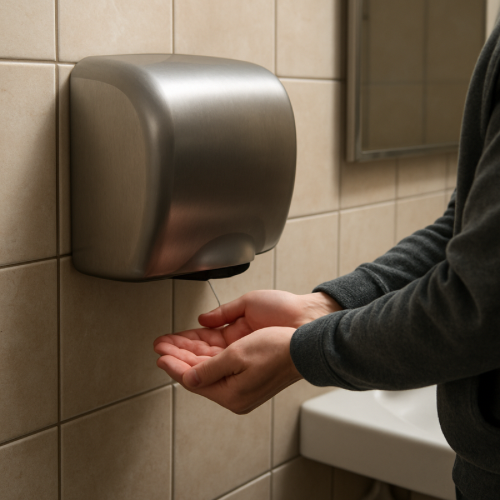
Why Do Hand Dryers Turn Off Too Quickly?
You put your hands under a hand dryer, the air starts, and then it suddenly shuts off before your hands are dry. You move your hands around, it starts again, and then stops again a few seconds later.
This can feel annoying, especially when you are clearly still using it. But in most cases, the dryer is not broken. It is reacting to how its sensor system is designed to detect your hands and control airflow.
The Short Answer
Hand dryers turn off too quickly because their sensors rely on a narrow detection zone and built-in timing controls that can stop airflow when your hands move out of position or the cycle resets.
How Automatic Hand Dryers Work
Most automatic hand dryers use infrared sensors. These sensors send out an invisible signal and wait for it to reflect back when your hands are in the correct spot.
Once the signal is detected, the dryer turns on. When the signal disappears, the dryer turns off.
That means the dryer is not really deciding whether your hands are dry. It is only deciding whether it still detects your hands in the right place.
Why the Detection Zone Feels So Small
Hand dryers are usually designed with a limited detection area. This helps prevent the dryer from turning on every time someone walks past or waves a hand nearby.
Because the sensor area is narrow, even a small shift in hand position can break the signal. When that happens, the dryer assumes your hands are gone and shuts off.
This is similar to why public restroom sensors sometimes do not detect your hands, where the system depends on precise placement rather than general movement.
Why It Shuts Off Even When You’re Still There
From your point of view, your hands are still under the dryer. But from the sensor’s point of view, they may have moved slightly too high, too low, or too far forward.
Even a small change in angle can affect how the reflected signal reaches the sensor.
That is why the dryer may stop even though it seems like you have barely moved.
Built-In Timers Also Matter
Many hand dryers use short timed cycles. Once activated, they may run for a certain number of seconds before expecting a new signal or a continued strong signal.
This helps reduce wasted electricity and prevents the dryer from running continuously if something accidentally triggers it.
If the signal weakens during that cycle, the dryer may stop early instead of continuing until your hands are dry.
Why The System Is Designed This Way
Public restroom devices are designed for hygiene, energy savings, and reliability. The dryer needs to activate quickly when used, but it also needs to avoid running constantly when no one is there.
So the system is built to be cautious. It is better for the dryer to shut off a little early than to keep blowing air with no user present.
This is the same basic tradeoff behind why automatic toilets sometimes flush at the wrong time: these systems prioritize sensor-based automation, even when the timing feels off to a person using them.
Real-World Example
For example, you may hold your hands under the dryer and slowly rotate them to dry your fingertips. As you change position, part of your hand moves outside the sensor’s strongest range. The dryer then shuts off because it no longer detects the same reflection pattern.
When you move your hands back, it turns on again.
What To Expect
In most cases, the dryer will work best if you keep your hands in the area directly below the sensor and move them slowly rather than waving them around.
If the system is working normally, small position adjustments should turn it back on quickly.
If the dryer shuts off constantly no matter where you place your hands, the sensor may be dirty, misaligned, or in need of maintenance.
A Simple Way To Think About It
Think of the dryer like a flashlight beam pointed at a very specific spot. As long as your hands stay in that beam, the dryer “sees” them. Once they drift outside it, even slightly, the dryer thinks you’re gone.
When It’s Normal vs Unusual
It is normal for automatic hand dryers to shut off briefly if your hands move outside the detection zone.
It is less normal if the dryer only runs for a second or two every time, or if it fails repeatedly even with careful hand placement. In that case, the sensor or control system may need service.
The Bottom Line
Hand dryers turn off too quickly because they rely on precise sensor detection and short control cycles, not on whether your hands are actually dry. Small shifts in position can make the system think you have moved away, which causes the airflow to stop even while you are still using it.