Why Do Public Restroom Sensors Not Detect My Hands?
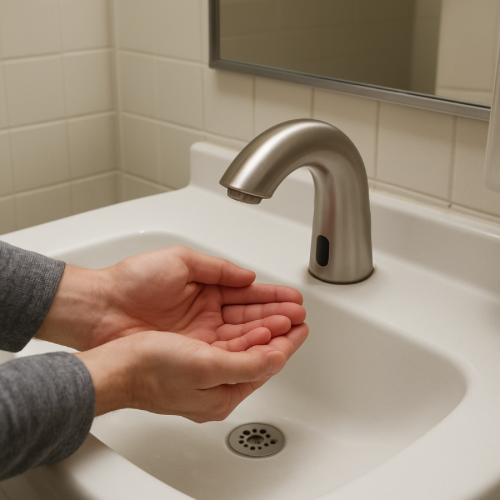
You place your hands under a faucet, soap dispenser, or hand dryer—and nothing happens. You move your hands around, wave them, try again, and still no response.
This can feel frustrating, but it usually comes down to how these sensor systems are designed to detect movement and position.
The Short Answer
Public restroom sensors may not detect your hands because they rely on specific positioning, detection zones, and environmental conditions to activate.
How Restroom Sensor Systems Work
Most restroom devices use infrared sensors. These sensors send out a signal and wait for it to reflect back when something—like your hands—is in the correct position.
If the reflection is strong enough and in the right spot, the system activates.
This is the same system behind why automatic faucets turn off while washing, where small changes in position affect detection.
Positioning Matters More Than You Think
The sensor is aimed at a specific area. If your hands are too far away, too close, or slightly off to the side, the system may not detect them.
Even small adjustments can make the difference between activation and no response.
Detection Zones Are Limited
These systems are designed to avoid turning on accidentally. Because of that, the detection zone is narrow and precise.
If the sensor doesn’t receive the expected signal, it simply stays off.
Lighting and Surface Reflection
Lighting conditions and reflections can affect how the sensor works. Bright light, shadows, or reflective surfaces can interfere with the signal.
This can make the system less responsive in certain environments.
Sensor Sensitivity and Timing
Some systems require a steady signal for a brief moment before activating. If your hands move too quickly or don’t stay in position long enough, the sensor may not trigger.
This is similar to how hand dryers turn on and off based on detection timing.
Real-World Example
For example, you place your hands under a faucet but slightly to the side of the sensor. Nothing happens. When you move your hands directly under the sensor and hold them still for a moment, the water turns on.
What to Expect
In most cases, adjusting your hand position or holding still for a second will activate the system.
If the sensor is dirty or blocked, it may not respond until it is cleaned or maintained.
Different devices may respond differently depending on their settings and environment.
A Simple Way to Think About It
Think of the sensor like a small spotlight—it only “sees” what’s directly in front of it. If your hands are outside that beam, it won’t detect them.
When It’s Normal vs Unusual
It is normal for sensors to be a bit sensitive to positioning and timing.
If multiple devices fail to detect your hands consistently, there may be a maintenance or calibration issue.
The Bottom Line
Public restroom sensors may not detect your hands because they rely on precise positioning and environmental conditions. Small adjustments usually solve the issue, even if it feels inconsistent at first.