Why Do Parking Garage Signs Show Available Spaces Even When It’s Full?
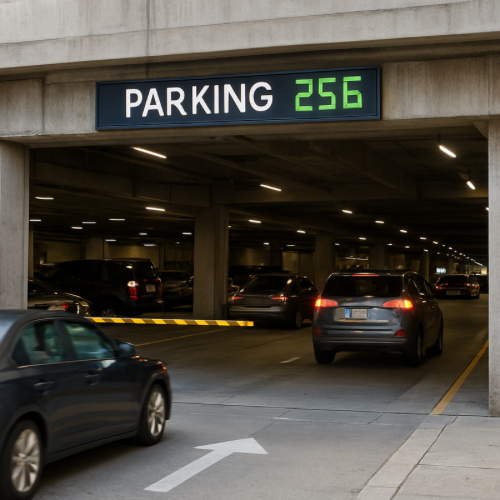
You drive up to a parking garage and see a sign that says there are available spaces. You pull in, go up a level, then another… and realize there are no open spots anywhere. This can feel confusing and frustrating, especially when the sign clearly suggested there was room.
These signs are not guessing randomly. They are connected to systems designed to estimate how many spaces are available. However, those systems are not always perfectly synchronized with real-time conditions inside the garage.
The Short Answer
Parking garage signs may show available spaces even when it feels full because the system relies on sensors, counts, and timing updates that do not always reflect real-time conditions exactly.
How Parking Garage Counting Systems Work
Most parking garages do not track each individual space in real time. Instead, they track how many cars enter and exit the garage. When a car enters, the system subtracts one from the available count. When a car exits, it adds one back.
This creates a running total of how many spaces should be available.
Some newer garages use individual space sensors or cameras, but many still rely on entry and exit counting as the primary method.
Why The Count Can Be Off
Even small errors can add up over time. If one car enters without being counted correctly, or if an exit is missed, the system’s total becomes slightly inaccurate. Multiply that across many vehicles, and the displayed number can drift away from reality.
For example, the system might think there are 10 spaces left, but in reality, those spaces are already taken.
Timing Delays Matter
The sign at the entrance does not always update instantly. There can be a delay between when a car exits and when the system updates the count. During busy times, this delay can become noticeable.
By the time you enter, the available spaces shown on the sign may already be taken by other drivers who entered just before you.
Not All Spaces Are Equal
Even if a garage technically has open spaces, they may not be easy to find or usable for every driver. Some spaces may be reserved, too small, blocked temporarily, or located in areas that are already congested.
So the system might show availability, but from your perspective, the garage feels full because the remaining spaces are not practical.
Peak Traffic Creates Mismatches
During busy times, many cars may enter the garage within a short period. Even if the system is accurate, those drivers are all competing for the same remaining spaces.
This means that by the time you reach a parking level, someone else may have already taken the spot that was technically “available” when you entered.
Why Garages Use These Systems Anyway
Even though they are not perfect, availability signs still help guide traffic. Without them, drivers would have no idea whether a garage is full before entering.
The system provides a general estimate that works well most of the time, even if it occasionally leads to mismatches during peak usage.
When It’s Normal vs Unusual
It is normal for parking garage signs to be slightly off, especially during busy periods.
If the sign is consistently very inaccurate or always shows availability when the garage is clearly full, the system may need recalibration or maintenance.
The Bottom Line
Parking garage signs sometimes show available spaces even when the garage feels full because they rely on counting systems and timing updates that are not perfectly synchronized with real-time conditions. The numbers are usually estimates rather than exact, moment-by-moment measurements.