Why Do Motion Sensors Work Better for Some People Than Others?
You wave your hand or walk past a motion sensor—and nothing happens. Then someone else does the same thing, and it works immediately.
This can feel like the sensor is inconsistent or even “picky,” but it usually comes down to how the system detects movement and signals.
The Short Answer
Motion sensors may work better for some people because they rely on specific movement patterns, positioning, and signal detection that can vary from person to person.
How Motion Sensors Detect Movement
Most motion sensors detect changes in signals, such as heat, infrared light, or reflected waves. They are not actually “seeing” a person—they are detecting changes in their environment.
If the change is strong and clear, the sensor activates.
This is similar to why restroom sensors sometimes don’t detect your hands, where detection depends on how well the signal is received.
Movement Style Makes a Difference
Some sensors respond better to larger or more direct movement. A person who moves quickly or directly through the detection area is more likely to trigger the sensor.
Someone moving slowly or at an angle may not create a strong enough signal change.
Positioning and Angle
Sensors are aimed at specific areas. If one person stands directly in that zone and another is slightly outside it, the results can be different.
Even small differences in position can affect detection.
Clothing and Temperature Effects
Some sensors rely on heat differences between a person and the surrounding environment. Clothing, body temperature, and background conditions can affect how strong that signal appears.
This can make detection more or less consistent between people.
Sensor Sensitivity and Settings
Sensors are often calibrated to avoid false triggers. This means they may ignore weaker signals to prevent turning on unnecessarily.
This can make them seem more responsive to some people than others.
It’s the same tradeoff seen in why hand dryers turn off too quickly, where the system prioritizes controlled activation over constant operation.
Real-World Example
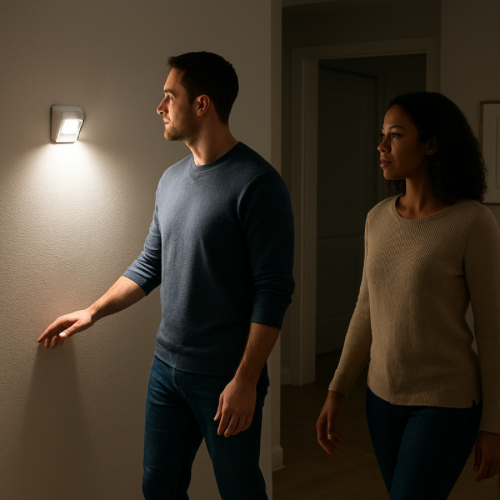
For example, one person may walk quickly under a sensor and trigger it immediately. Another person may stand slightly off to the side or move slowly, and the sensor does not activate until they adjust their position.
What to Expect
In most cases, adjusting your position or making a more direct movement will trigger the sensor.
If the system is working properly, it should respond once the signal is strong enough.
If it consistently fails for everyone, the sensor may need cleaning or adjustment.
A Simple Way to Think About It
Think of the sensor like a spotlight looking for movement in a specific area. If the movement is clear and in the right spot, it reacts. If not, it may miss it.
When It’s Normal vs Unusual
It is normal for motion sensors to respond differently based on movement, position, and conditions.
If the sensor rarely works for anyone, there may be a calibration or maintenance issue.
The Bottom Line
Motion sensors work better for some people because they rely on specific signals and positioning. Differences in movement, angle, and conditions can affect how clearly the sensor detects a person.