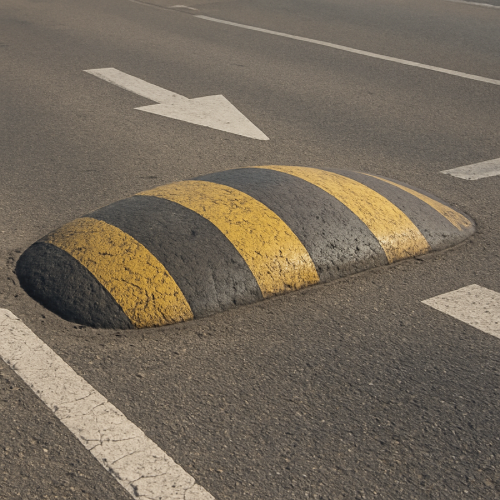
What Determines the Shape of Road Speed Bumps?
The shape of road speed bumps is determined by vehicle suspension behavior, target traffic speeds, safety standards, and drainage considerations.
Vehicle Dynamics and Suspension Response
When a vehicle crosses a raised surface, its suspension compresses and rebounds.
A rounded bump spreads this motion over a slightly longer distance, reducing sudden impact.
Sharper designs create more abrupt vertical movement and stronger deceleration.
Speed Control Objectives
Different bump shapes are used depending on the desired speed reduction.
Taller, shorter bumps force vehicles to slow significantly.
Longer, flatter humps allow moderate speeds while discouraging fast travel.
Safety Standards and Accessibility
Municipal guidelines often specify maximum heights and slopes.
These limits reduce risk to emergency vehicles, bicycles, and low-clearance cars.
Excessively steep bumps can damage vehicles or cause loss of control.
Drainage and Road Surface Integration
The bump must not trap water along its edges.
Open channels or tapered ends are often included to allow stormwater to flow past.
Material and Maintenance Constraints
Speed bumps may be made from asphalt, rubber, or modular composite materials.
The chosen material affects the achievable curvature and long-term durability.
Design Tradeoffs
More aggressive shapes increase speed reduction but can generate noise and vehicle wear.
Gentler shapes reduce complaints but may not slow traffic as effectively.
Common Traffic-Calming Engineering Practice
The rounded form represents a balance between effective speed control and structural durability.
The shape is engineered rather than decorative.