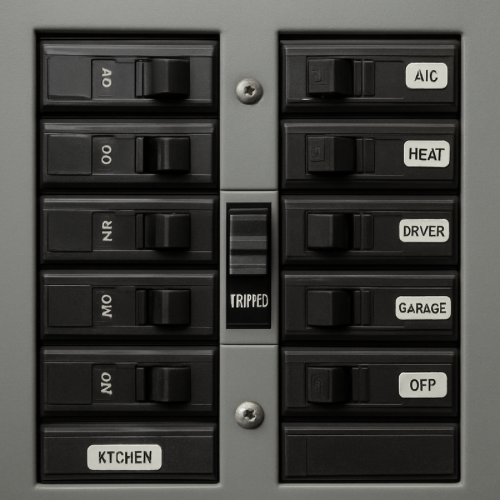
Why Do Some Circuit Breakers Trip Without Anything Plugged In?
A circuit breaker can trip even when nothing is visibly plugged in due to wiring faults, hidden loads, ground faults, or internal breaker issues.
Hardwired Devices
Not all electrical loads plug into outlets.
Lights, smoke detectors, fans, and built-in appliances may share the same circuit.
Shared Circuit Layouts
Multiple rooms or outlets may be connected to one breaker.
Power draw elsewhere can cause a trip.
Ground Fault Conditions
Moisture or damaged wiring can create a leakage path to ground.
GFCI and AFCI breakers detect these conditions and shut off power.
Arc Fault Detection
Modern breakers monitor electrical patterns.
Irregular arcing in wiring can trigger a trip even without heavy load.
Wiring Damage
Loose connections or damaged insulation can create intermittent faults.
These may occur behind walls or in junction boxes.
Breaker Wear
Breakers can weaken over time.
An aging breaker may trip at lower thresholds than intended.
Electrical System Practice
A breaker trips to prevent overheating or fire risk.
Even without visible appliances connected, underlying circuit conditions can activate protection mechanisms.