Why Does My Credit Card Show a Temporary Authorization That Disappears Later?
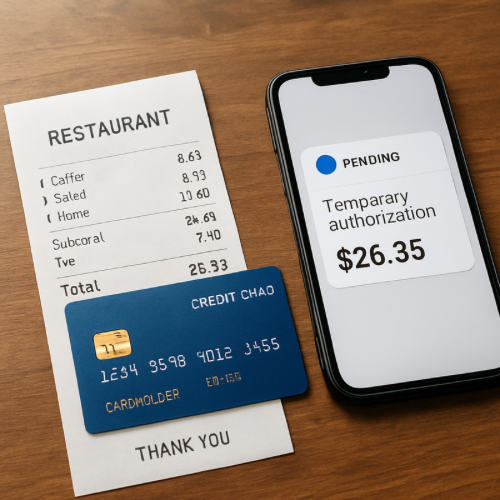
A temporary authorization appears when a merchant checks whether your credit card is valid and whether sufficient credit is available. It is not a completed charge.
If the transaction moves forward, the authorization converts into a posted charge. If it is canceled, adjusted, or never finalized, the authorization may disappear entirely.
What a Temporary Authorization Actually Is
When you enter your card information, the merchant sends a request through the card network to your issuing bank.
The bank verifies that the account is active and that enough credit is available. If approved, the system places a temporary hold for the estimated amount. This reduces your available credit but does not yet move money.
This is different from a charge that is already settled. If you’re unsure how settlement works, you may also see a charge labeled as “payment processing” but not yet posted.
Why Merchants Use Authorizations
Merchants use authorizations to protect themselves before completing a transaction.
For example, restaurants may authorize the base bill amount before a tip is added. Gas stations often authorize a larger amount than the final purchase. Hotels frequently place holds to cover incidental charges.
This ensures funds will be available once the final amount is determined.
Why the Amount May Change
The authorization amount is sometimes only an estimate.
After the final total is calculated, the merchant submits the actual charge for settlement. The original authorization is replaced by the final posted amount.
This can make it appear as though one charge disappeared and another appeared.
Why an Authorization Disappears Completely
If the merchant does not finalize the transaction, the authorization expires automatically.
This can happen if:
- An online order is canceled before shipment.
- A transaction fails before completion.
- A duplicate swipe is voided immediately.
- A pre-authorization is never converted to a final charge.
Most authorizations expire within one to five business days, depending on the merchant category and your card issuer.
Authorization vs Posted Charge
An authorization is a temporary hold.
A posted charge means the transaction has completed settlement between financial institutions. At that point, the charge becomes part of your official statement balance.
If you notice differences between your current balance and available credit, that may relate to how holds are handled. You can also read more about why available balance is different from current balance.
Real-World Examples
Gas Station: The pump authorizes $100, but you only purchase $42 of fuel. The $100 hold disappears and is replaced by the final $42 charge.
Hotel Stay: A $200 incidental hold appears at check-in. After checkout, the hold drops off if no extra charges were added.
Online Purchase: You place an order but cancel it before it ships. The authorization appears briefly, then disappears when the order is voided.
When It’s Normal vs When It’s Unusual
It is normal for temporary authorizations to disappear within several business days.
It may be unusual if:
- The hold remains longer than seven business days.
- The authorization converts into multiple posted charges unexpectedly.
- Your available credit does not restore after expiration.
In those cases, contacting the merchant first is usually the fastest resolution.
What This Means for You
A disappearing authorization does not mean money was taken and returned.
It means the hold expired or the transaction did not move to final settlement. During the hold period, your available credit may appear lower, but no finalized charge exists unless it posts.
Bottom Line
A temporary authorization is a short-term verification hold placed by a merchant. If the transaction is not completed or is adjusted, the authorization may disappear without ever becoming a posted charge.