Why Do Some Machines Reject New Bills?
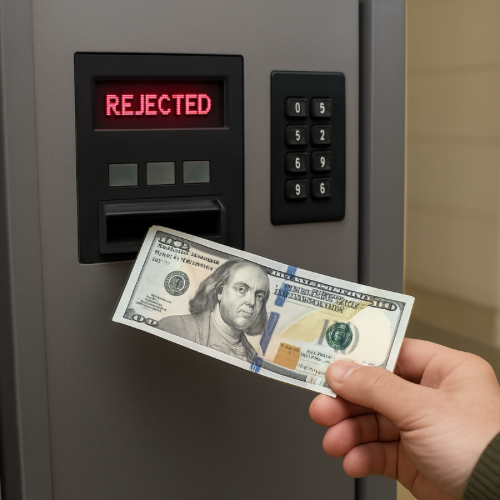
You try to insert a brand-new bill into a vending machine or kiosk, and it keeps getting rejected. You smooth it out, try again, and still nothing. But an older, worn bill works just fine.
This can feel backward, but it happens because of how machines are designed to read and handle paper money.
The Short Answer
Machines reject new bills because their sensors and feeding systems are calibrated for flexible, worn bills and may have trouble reading or pulling in crisp ones.
How Machines Read Bills
When you insert a bill, the machine uses sensors to scan it. These sensors look for patterns, markings, and security features to confirm the bill is real.
At the same time, rollers pull the bill through the machine so it can be read properly.
Why New Bills Are Harder to Process
New bills are stiffer and smoother than older ones. This can make them harder for the machine’s rollers to grip and feed evenly.
If the bill doesn’t move smoothly through the system, the machine may reject it.
Sensor Calibration Matters
Machines are often calibrated based on typical bills in circulation, which are slightly worn. A crisp bill may reflect light differently or pass through the sensors in a way that doesn’t match expected patterns.
This can cause the machine to reject it even though it’s valid.
Position and Alignment
New bills tend to stay perfectly flat, which might seem like a good thing, but it can actually make alignment more sensitive. If the bill is not positioned exactly right, the machine may not read it correctly.
This is similar to how vending machines rely on precise positioning for mechanical actions, where small differences can affect the outcome.
Why Worn Bills Work Better
Older bills are softer and more flexible. They bend slightly as they move through the machine, which helps the rollers grip them and guides them more smoothly past the sensors.
This makes them easier for the system to process.
Real-World Example
For example, you might try to use a crisp $10 bill at a vending machine, and it keeps getting rejected. Then you use an older bill, and it works on the first try.
The difference isn’t the value—it’s how the bill interacts with the machine.
What to Expect
In many cases, slightly bending or flattening a new bill can help it feed better into the machine.
Trying a different angle or reinserting it slowly may also work.
If the machine consistently rejects multiple bills, it may need maintenance.
A Simple Way to Think About It
Think of the machine like a paper feeder—it works best with paper that has a little flexibility. A perfectly stiff sheet can be harder to pull through smoothly.
When It’s Normal vs Unusual
It is normal for machines to occasionally reject new bills.
If all bills are being rejected, the machine may have a sensor or mechanical issue.
The Bottom Line
Machines reject new bills because their sensors and feeding systems are designed for slightly worn, flexible currency. The stiffness and smoothness of new bills can make them harder to read and process correctly.