Why Does My Savings Account Interest Post Only Once a Month?
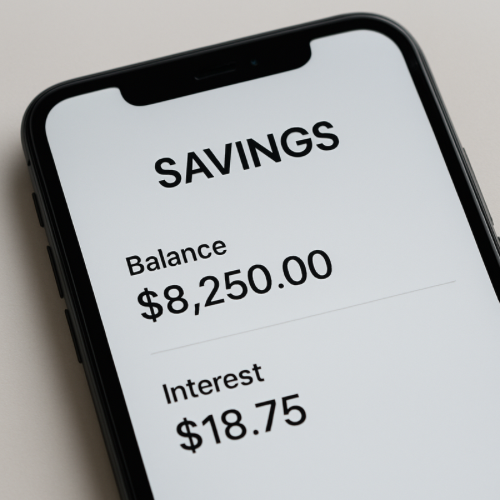
If your savings account interest posts only once a month, it is because most banks calculate interest daily but credit it to your account in a single monthly settlement entry.
The interest is building behind the scenes each day, even though you only see one deposit at the end of the statement cycle.
Daily Accrual vs Monthly Posting
Most savings accounts use what is called the daily balance method. Each day, the bank:
- Calculates your end-of-day balance
- Applies the daily interest rate
- Adds that amount to an internal accrued interest total
The daily interest rate is typically calculated by dividing the annual rate by 365.
For example, if your account earns 3.65% annually, the approximate daily rate would be 0.01% per day (3.65 ÷ 365).
If you had $10,000 in the account, one day of interest would be about $1.00. That $1.00 is recorded internally but not immediately posted as a transaction.
Why Banks Do Not Post Interest Daily
Even though interest accrues daily, banks usually credit it monthly for accounting efficiency.
Posting daily interest would create hundreds of micro-transactions per year. Instead, the bank:
- Accumulates all daily interest amounts
- Totals them at the end of the statement cycle
- Posts one combined interest credit
This is part of batch settlement processing, similar to how other transactions may not immediately post to the official ledger.
For example, an authorization hold reduces available funds immediately but does not post to the ledger until final settlement.
How Statement Cycles Affect Interest Posting
Interest posting typically aligns with your statement closing date, not the calendar month.
If your statement cycle runs from the 15th to the 14th, interest may post on the 14th — even if that is not the last day of the month.
This timing is tied to accounting periods rather than daily accrual activity.
Compounding Frequency vs Posting Frequency
It is important to separate two concepts:
- Accrual frequency (how often interest is calculated)
- Posting frequency (how often interest is credited)
Even if interest posts monthly, it may still compound daily because each day’s calculation uses the updated balance.
The annual percentage rate (APR) represents the yearly rate applied to the balance. You can read more about how APR functions in financial products in our explanation of APR meaning.
Why the Interest Amount Can Vary
Your monthly interest credit may change because:
- Your balance changed during the month
- You made withdrawals or deposits
- The bank adjusted the annual rate
- The statement cycle contained more or fewer days
Since interest is calculated daily, even small balance changes can affect the final posted amount.
Real-World Example
Suppose you maintain $10,000 for 30 days at 3.65% annual interest.
Daily interest is approximately:
$10,000 × 0.0365 ÷ 365 = $1.00 per day
Over 30 days, that totals approximately $30.00.
Instead of seeing $1.00 appear every day, you will see one $30.00 interest credit at the end of the statement cycle.
When It’s Normal vs When It’s Unusual
Normal
- Interest posts once per statement cycle
- Posting date aligns with statement close
- No daily visible interest entries
Unusual
- Interest does not post at statement close
- Posted interest does not align with balance changes
- Account terms specify a different credit frequency
What This Means for You
If interest only posts once a month, it does not mean it is calculated monthly.
It usually means the bank is accruing interest daily but crediting it in one batch entry for accounting consistency.
Bottom Line
Savings account interest typically accrues daily and posts monthly because banks separate calculation from settlement. The daily accrual builds internally, and the combined total appears at the end of your statement cycle as a single interest credit.